
Technology Foundation
Sterilization Science
Non-ionizing methodology derived from regulated biological processing.
VHP (vaporized hydrogen peroxide) achieves 6-log microbial reduction at temperatures below 94°F, eliminating Aspergillus and other contaminants without degrading cannabinoids or terpenes.
The Technology
Vaporized hydrogen peroxide delivered under extreme vacuum enables vapor-phase diffusion throughout complex biological material—penetrating beyond surface boundaries into the material matrix.
The controlled vacuum chamber environment ensures consistent distribution and contact. Validated parameters govern exposure duration, concentration, and environmental conditions—producing repeatable, documented outcomes.
Post-process decomposition is complete and chemically irreversible: VHP breaks down entirely to H₂O and O₂—water vapor and oxygen. Zero chemical residue. Zero molecular damage. This is not a trace-level outcome; it is the inherent end-state of the chemistry, and it is why pharmaceutical-grade application is viable.
What It Is Not
—Ionizing radiation
—Ozone-based processing
—Thermal sterilization
—Ambient fogging or misting
—Surface-only decontamination
What It Is
—Controlled vacuum sterilization
—Vapor-phase diffusion process
—Deep penetrative exposure
—Low-temperature compatible
—Decades of validated application
Foundation
Non-Ionizing Process
Microbial disruption without ionizing energy—material chemistry remains unaltered by the process.
Preservation
Material Integrity
Selective action—parameters that microorganisms cannot tolerate but sensitive compounds can.
Validation
Documented Efficacy
Log reduction measured against scientific standards. Repeatable parameters. Consistent outcomes.
Why Non-Ionizing Matters
Ionizing Radiation
Gamma rays, X-rays, and electron beams carry enough energy to break molecular bonds indiscriminately. Effective for sterilization, but can alter material chemistry in unintended ways.
Vacuum-Enabled VHP
VHP delivered under extreme vacuum achieves microbial disruption through deep vapor-phase diffusion—without the penetrating energy that can alter material chemistry. Molecular structure remains intact.
Method Comparison
Not all sterilization methods are equivalent. These distinctions matter at the regulatory level.
| Attribute | TheBOX® (VHP) | Ionizing Radiation | Ozone | Traditional Remediation |
|---|---|---|---|---|
| Pharma heritage | FDA-regulated sterilization | Industrial sterilization | Industrial / water treatment | None |
| FDA Established Category A | Yes (January 2024) | Yes (legacy) | No (Category B) | No |
| Standards-based self-validation | ISO 22441:2022 | ISO 11137 (facility not operator-accessible) | No recognized standard | No validation pathway |
| Residuals | Zero (H₂O + O₂) | None, but molecular damage | Ozone residuals possible | Chemical residuals |
| Molecular integrity | Preserved | Compromised (bond-breaking) | Surface-only treatment | Variable |
| Audit documentation | Built-in, lot-level | Batch-level at best | Minimal | Typically none |
| Schedule III pathway | Direct (pharma-grade) | Partial | Unlikely | Not applicable |
Selective Action
Microorganisms and plant-derived compounds respond differently to this process. System design exploits this differential susceptibility.
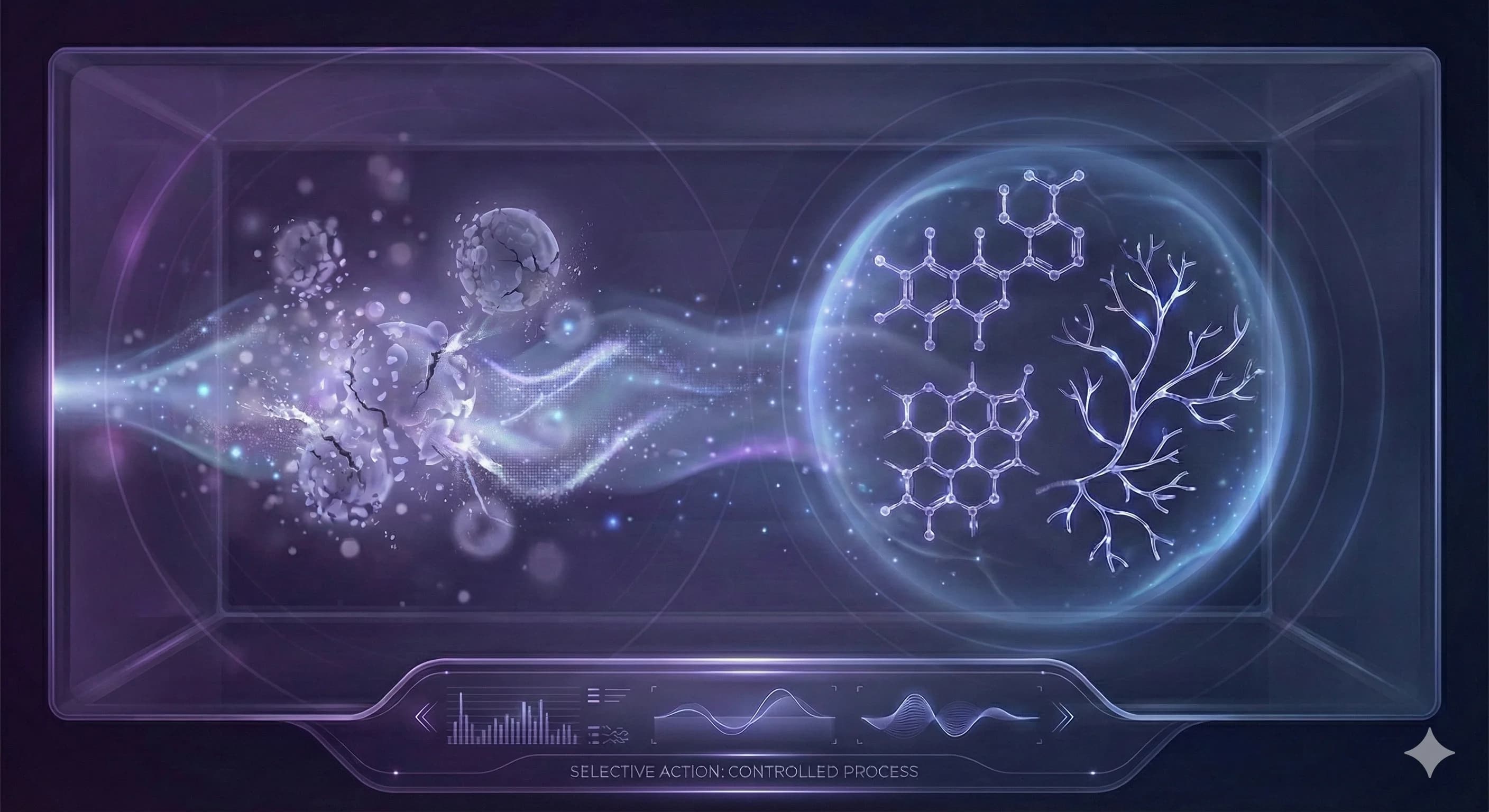
Differential Susceptibility
Microbial structures are vulnerable at concentrations and durations that do not significantly impact cannabinoid or terpene chemistry. This selectivity is the basis of process design.
Parameter Control
• Exposure duration: Managed to achieve efficacy without excess
• Concentration: Maintained within validated range
• Environment: Temperature, humidity, and pressure regulated
Scientific Background
Established Use
Vaporized hydrogen peroxide has been recognized as a sterilant for nearly five decades — from its 1979 patent as a cold sterilization alternative from ethylene oxide, through its first FDA clearance for medical device sterilization in 1993, to its formal designation as an Established Category A method in January 2024. It is not a technology adapted from pharmaceutical applications — it is a pharmaceutical technology, one that has governed sterilization in the most demanding regulated environments on earth. The technology behind TheBOX® draws on this lineage through PuroGen's 22+ years of operating VHP within FDA-regulated biological processing — specifically, the sterilization of human allograft tissue for surgical implantation. ISO 14937, ISO 22441, and ISO 10993 compliance frameworks were built around it. The Category A designation also established ISO 22441:2022 as an FDA-recognized consensus standard — providing a published, internationally accepted framework for process validation that operators can validate against directly, rather than building and defending proprietary protocols from scratch.
• Medical device sterilization: Electronics, polymers, optical components, sensors, and battery-containing devices that cannot tolerate thermal or ionizing methods
• Human tissue processing: Allograft tissue prepared for clinical transplantation under FDA oversight, where irradiation or heat would compromise biological structure and osteoinductive function
• Pharmaceutical manufacturing: Cleanroom and isolator decontamination in environments requiring validated sterility without residue—the standard against which all others are measured
• Hospital environments: Operating suites, patient rooms, and critical care areas where rapid turnaround and material compatibility are required
When the most delicate sterilization challenges arise—across healthcare, pharmaceutical, and advanced manufacturing—VHP is the established methodology of record. TheBOX® brings that same lineage to cannabis.
Cannabis Application
Cannabis presented a constraint-driven engineering problem. Dried flower is a moisture-bearing, chemically volatile botanical material—conditions that commercially available VHP systems are not designed to accommodate. Standard VHP equipment will not initiate in the presence of meaningful residual moisture and lacks the programmability required to adapt to moisture-bearing biological loads.
The core technology was originally developed by PuroGen, the parent company, for human tissue sterilization in the transplant industry. Human allograft tissue presented similar preservation constraints: moisture sensitivity and the requirement to preserve osteoinductivity and osteoconductivity—biological properties essential to surgical outcomes.
The parallel between preserving biological performance in tissue and preserving terpenes, cannabinoids, and moisture behavior in cannabis informed the engineering approach. TheBOX® was purpose-engineered to operate in moisture-bearing biological materials using controlled vapor-phase diffusion under extreme vacuum—achieving microbial elimination alongside preservation, not at the expense of it.
Adaptation of this technology to cannabis began in 2015. More than 100 units have since been deployed across U.S. and international markets.
Technology Lineage
Nearly five decades of VHP sterilization science. More than two decades of PuroGen operating within it.
1975
Patent application filed
Hydrogen peroxide vapor sterilization — Moore & Perkinson
1975
Patent application filed
Hydrogen peroxide vapor sterilization — Moore & Perkinson
1979
US Patent #4,169,123 granted
Cold sterilization alternative to ethylene oxide and radiation
1979
US Patent #4,169,123 granted
Cold sterilization alternative to ethylene oxide and radiation
1991
STERIS launches VHP 1000 commercially
First broad pharmaceutical deployment of VHP technology
1991
STERIS launches VHP 1000 commercially
First broad pharmaceutical deployment of VHP technology
1993
First FDA clearance: STERRAD 100
Advanced Sterilization Products / J&J — medical device sterilization
1993
First FDA clearance: STERRAD 100
Advanced Sterilization Products / J&J — medical device sterilization
2002
FDA formalizes VHP in aseptic guidance
FDA addresses VHP isolator decontamination in revised aseptic processing guidance
2002
FDA formalizes VHP in aseptic guidance
FDA addresses VHP isolator decontamination in revised aseptic processing guidance
2003
PuroGen begins FDA-regulated VHP operations
Human allograft tissue sterilization for surgical transplantation under FDA oversight
2003
PuroGen begins FDA-regulated VHP operations
Human allograft tissue sterilization for surgical transplantation under FDA oversight
2015
TheBOX® development begins
PuroGen adapts VHP technology for dried cannabis flower
2015
TheBOX® development begins
PuroGen adapts VHP technology for dried cannabis flower
2022
ISO 22441:2022 published
First international VHP sterilization standard
2022
ISO 22441:2022 published
First international VHP sterilization standard
2024
FDA Established Category A designation
FDA designates VHP as Established Category A; recognizes ISO 22441:2022
2024
FDA Established Category A designation
FDA designates VHP as Established Category A; recognizes ISO 22441:2022
2024
TheBOX® surpasses 100 deployed units
U.S. and international cannabis markets
2024
TheBOX® surpasses 100 deployed units
U.S. and international cannabis markets
The FDA's 2024 Category A designation did not just validate VHP's history — it published the framework for companies to validate their own VHP processes. By recognizing ISO 22441:2022 as the governing consensus standard, the FDA established a standards-based self-validation pathway: defined acceptance criteria, established methodology, documented routine control. For cannabis operators who must self-validate because FDA-certified facilities cannot handle THC-containing products, this distinction is structural. It is the difference between defending a proprietary process to every auditor who encounters it and demonstrating compliance with a framework that auditors already recognize.
FDA Sterilization Classification
The FDA categorizes sterilization methods into three tiers based on regulatory history, published evidence, and recognized consensus standards. Classification determines the validation burden, documentation requirements, and regulatory scrutiny applied to each method.
| Attribute | Category A | Category B | Novel |
|---|---|---|---|
| FDA-recognized consensus standard | Yes | No | No |
| Validation approach | Reference standard | Custom validation | Full custom from scratch |
| Documentation burden | Reduced (standard-based) | Moderate (evidence-based) | Highest (novel justification) |
| Regulatory defensibility | Strongest — standard is known | Moderate — methodology must be evaluated | Weakest — everything must be justified |
Cannabis Method Mapping
| Cannabis Method | FDA Tier | Recognized Standard | Self-Validation Framework |
|---|---|---|---|
| VHP / TheBOX® | Established Category A | ISO 22441:2022 | Standards-based: validate against published framework |
| Ozone | Established Category B | None (FDA-recognized) | Proprietary: custom protocol, no standard reference |
| Ionizing Radiation | Established Category A | Multiple (ISO 11137) | Standards-based — facility not operator-accessible for cannabis |
| Traditional Remediation | Not classified | None | No standardized validation pathway exists |
Source: FDA Final Guidance, “Submission and Review of Sterility Information in Premarket Notification (510(k)) Submissions for Devices Labeled as Sterile,” Revised January 2024
Why This Matters for Cannabis Adoption
Cannabis operators cannot access traditional FDA-certified validation facilities — THC-containing products are prohibited from entering those facilities under current federal law. Self-validation is not a choice; it is a structural requirement of the industry.
When a company adopts a sterilization technology, the question regulators will ask is: how did you validate your process? The answer depends entirely on the FDA classification of the method used.
For Established Category A methods like VHP, validation is conducted against ISO 22441:2022 — a published, FDA-recognized consensus standard with defined acceptance criteria and established methodology. The validation is auditable by any competent authority, portable across regulatory jurisdictions, and defensible under federal scrutiny.
For Category B methods like ozone, no FDA-recognized standard exists. Validation protocols are proprietary and must be independently evaluated by every authority that encounters them. For unclassified methods, no standardized validation pathway exists at all.
The FDA's 2024 reclassification of VHP did not just recognize a technology — it gave every company adopting that technology a framework to validate and defend their own processes.
Reactive Oxygen®
Reactive Oxygen® is the branded name for the proprietary reagent and process framework integrated within TheBOX® system. It does not refer to uncontrolled reactive oxygen species and should not be interpreted as free-radical chemistry.
Within the Reactive Oxygen® framework, reactive activity is intentionally generated, transient, and spatially constrained—a function of defined process conditions rather than ambient chemical behavior. Microbial control is system-mediated: governed by chamber architecture, parameter control, and exposure boundaries—not by chemical aggressiveness alone. The extreme vacuum conditions also function as a preventative mechanism: by removing atmospheric oxygen and collapsing the physical environment that supports microbial respiration and colonization, the chamber creates conditions hostile to microbial survival before oxidative activity begins. Prevention and elimination are simultaneous, not sequential.
VHP undergoes complete decomposition at the close of every cycle—breaking down entirely into water vapor (H₂O) and oxygen (O₂). No chemical byproducts. No residual compounds on processed material. This is not a performance claim; it is the known end-state of the chemistry, independently verifiable, and the reason zero-residual sterilization is achievable at all.
The result is predictable, repeatable sterilization outcomes with material preservation as a design constraint, not a trade-off.
Non-ionizing
No material-altering radiation
VHP-based
Controlled reagent delivery
Zero residuals
Decomposes completely to H₂O + O₂ — no chemical trace
Deep diffusion
Vacuum-enabled penetration
Material preservation
Compound integrity maintained
System-mediated
Architecture-governed outcomes
Validation Philosophy
Demonstrating that a process consistently produces intended outcomes under defined conditions.
Log Reduction
Microbial reduction expressed in logarithmic terms—1-log represents 90% decrease; 3-log represents 99.9%. A scientific convention for standardized comparison.
Repeatability
Process parameters controlled with sufficient precision that the same inputs yield the same results across cycles, units, and facilities.
Documentation
Cycle parameters, lot identification, and process conditions captured and retained—the foundation of defensible claims about outcomes.
Consistency
System design, automation, and operator controls that translate validated parameters to real-world consistency.
Scope of Validation
Documented evidence across system efficacy, safety, and operational constraints.
System Efficacy
Biological Indicator Validation
—Industry-standard biological indicators
—Empty chamber testing (material-independent)
—~1,000,000 CFU (~6-log) reduction per cycle
—Demonstrates system capability
Internal Field Testing
—Internal plating within licensed operations
—Observed reductions: ~450,000 to 1,000,000 CFU
—Operational confirmation, not lab certification
—Material-dependent outcomes expected
Regulatory Testing Constraints
THC-containing cannabis cannot be sent to most accredited microbiology institutions. Controlled substance handling restrictions limit conventional third-party validation pathways. This structural constraint applies industry-wide and is not unique to any single manufacturer or system.
Material Variability
What Varies
—Flower density, porosity, internal structure
—Diffusion-dependent behavior in vapor-phase processes
—Heterogeneous biological material
What Does Not Vary
—System capability is constant
—Process parameters are governed
—Observed outcomes reflect material properties
Safety Validation
Human & Environmental
No residual compounds; decomposes to water and oxygen
Product Safety
Material integrity preserved; no ionizing energy
Biological Safety
Process does not alter molecular chemistry
Declared Validations
Third-party studies conducted under recognized standards and protocols.
References
ISO 22441:2022 — Sterilization of health care products — Low temperature vaporized hydrogen peroxide — Requirements for the development, validation and routine control of a sterilization process for medical devices
ISO 14937:2009 — Sterilization of health care products — General requirements for characterization of a sterilizing agent and the development, validation and routine control of a sterilization process for medical devices
ISO 10993-11:2017 — Biological evaluation of medical devices — Part 11: Tests for systemic toxicity
FDA Guidance Document — Submission and Review of Sterility Information in Premarket Notification (510(k)) Submissions for Devices Labeled as Sterile — Revised January 2024
EPA Registration — Hydrogen peroxide registered as a sterilant and high-level disinfectant under EPA antimicrobial registration requirements
Content last reviewed April 2026 by BoxPurify technical team
The process is validated. The parameters are documented. The outcomes are repeatable.
This is the scientific foundation. TheBOX® is the system that implements it for regulated cannabis operations.
Process Control for Regulated Cannabis Operations